
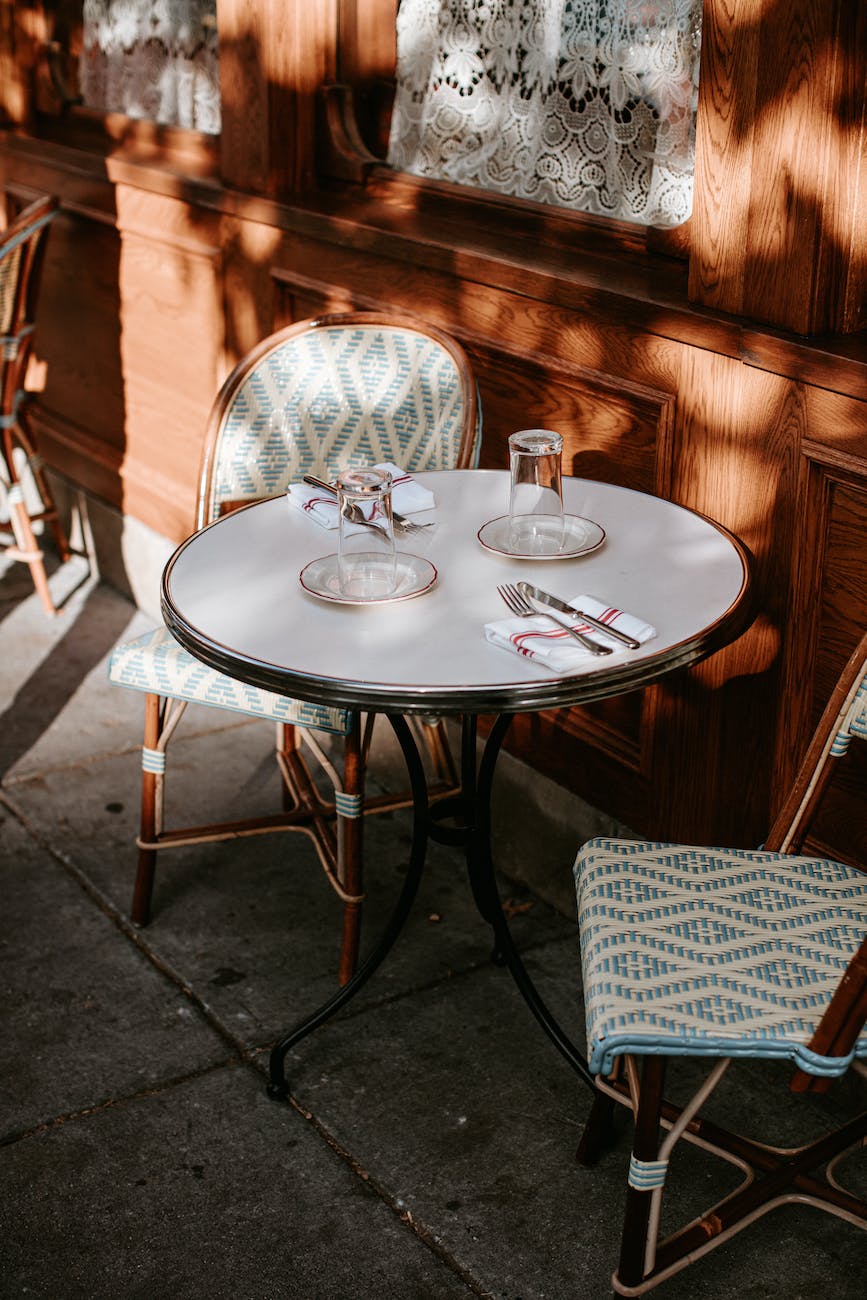
We are officially into Spring here in France…the trees are blossoming with light pink fluffy buds, the markets are full of flowers, citrus and olive trees, and lush, green herb plants, and there were hundreds of cartons of beautiful ripe, red strawberries at the Friday market this week. All of it certainly awakens my senses from the long winter–Darrell reminded me this week, we made it through our first winter in France–hurray! He also just got notice on Thursday evening that his residence card (titre de séjour) has been approved. Mine is next! Both will be valid for four years, so it appears we are set for the long haul.
Part of our integration into France and enjoying the warmer weather and beautiful surroundings has been our weekly (sometimes twice a week) lunches out. I will add that these lunches are the only time we eat out each week, not only because our evenings are busy checking in guests, but we have found le déjeuner in France to be a perfect mid-day treat–as a result, we spend less on eating out than we did in the US, but when we eat out it is quite the experience.
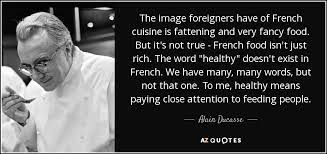
Let me say first that in France le déjeuner is on a whole other level than just “lunch.” It’s so much better than just scarfing down a quick bite at my desk in the middle of the day, as I did for most of my working career. At one point, I just ate a carton of yogurt with some blueberries and one tablespoon of granola–that was it. It was my attempt to eat healthy and stay fit. (How very sad!) As I am learning in France and as perfectly illustrated in the quote below, food is a celebration and how the French approach food is so very different than many of us have treated it–you know relegating things as “bad food” and “good food”–instead food is approached with purpose, intention, and it is carefully curated with love (no joke, it is on their menu) and locally sourced. Eating a french meal is not about excess or overindulging in “unhealthy” or “fattening” food. I’ll see if I can paint a good picture with a walkthrough of a French lunch, first what lunch is like on weekdays and then the ones offered on a Sunday (the most extravagant of the seven days.)
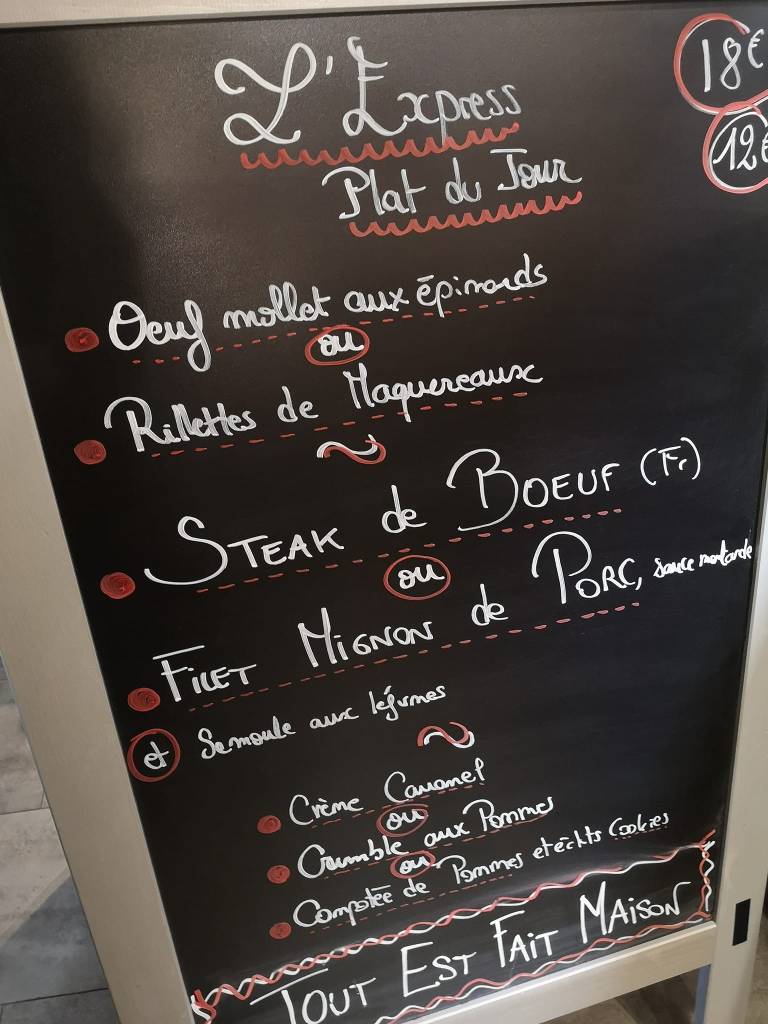
First, although many restaurants do have a limited menu one can order from, à la carte–the most common and popular way to order at lunch is to order from the set Plat du Jour menu, which usually includes an entrée (like an appetizer), Plat (main dish), and Dessert–all for a set price. We have found that the weekday prices are a bit lower, but the portions are also a bit smaller and the offerings not as decadent as Sunday offerings. Also, some Plat du Jours will come with a glass of wine as part of the total price. Sometimes there are two choices for each of the courses and sometimes just one choice, and the menu choices change daily.
The menus are printed on chalkboards and displayed outside, so you can see what is on offer before going into the restaurant and many restaurants now, like the ones below, post their menus on their Facebook page. This is great because I just take a picture and use Google Translate before we arrive, so I know exactly what I am going to be eating. It’s also important to plan ahead because restaurants are small and can only seat a certain number of tables. Almost all French people going out to lunch make a reservation first, so if you don’t make a reservation (which is still scary for me in my limited French) my trick is to go the restaurant as soon as it opens–they usually have 2-3 tables set aside for people like me with no reservations. Lunch is usually served between noon and 1:30. However, almost everyone is seated by 12:45–if you come later than that without a reservation, not only will their not be a table available, they may not seat you even if there is one because the kitchen needs to be preparing each course to go out within a regularly scheduled interval (entrée, plat, then dessert). So…without a reservation, get there at noon and with a reservation, get there on time.
Once you go inside, the server will bring the “inside version” of the great big chalkboard over to your table so you can order. This is quite funny as the board is huge and it usually has to be propped up next to someone else’s table while they are trying to eat. The French seem fine with this arrangement, as they know it won’t be there long and it is just part of the process. Another funny thing we have noticed is that if there is a big table for lunch–either the server or the party themselves will initiate a vote of who is having what for each course. They literally call out the dish and people raise their hands if they are going to have that particular choice. Also, you order all three courses at the same time, along with your drink order (though some choose to enjoy their drink first, while they deliberate).
Darrell and I have been to both La Confrérie du Bourg and Le Chabrot for weekday lunches, so I included their lunch menus below–notice that they both cost about 18 euros for the full meal. These restaurants are within 5-10 minutes of our B&B, quite small, and take great pride in serving only local ingredients. At Le Chabrot, you can pick two of the three courses for 12 euros. “Tout est fait maison” means it is all made in house and “avec amour” means it is made with love.
I did not include the drinks menu, but there is also a chalkboard or a small paper menu for the aperterif and wine list. Most people know that it is not unusual at all to have wine at lunch in France, even during the week, and unfortunately, some people have misinterpreted that to mean the French are excessive drinkers. The French, overall as I have observed, are conservative drinkers and really savor wine WITH their food. I have noticed if they have wine, they will only drink 1 glass at lunch and I’ve never seen a French person just drinking wine by itself. Also, the French pour of wine is a conservative 5-6 oz. pour–not true of the Brits here, many of whom fill their glasses to the rim and drink at any time, with or without food. So although, during the week the French may order wine, they often will only order a verre (glass) or Pichet (pitcher), which is about a glass for each person (small pichet for two people, larger one for four people). The cost of a glass of wine is about 3.50 euros and a pitcher ranges from 5 to 8 euros, depending on if you are going small to large. A coca-cola will actually cost you as much as a glass of wine.

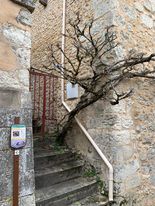
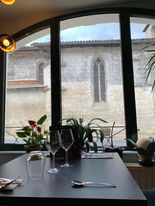
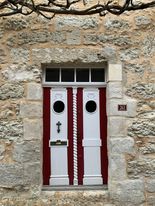
So…Sunday lunch, how is that different? One of our best experiences for Sunday lunch thus far was last Sunday at Le Saint-Aquilin, in a nearby village (absolutely gorgeous little town, Saint-Aquilin–I’ve added a few photos below). In many of these small villages, they only have one restaurant like this one–lucky them!
As in most other lunches, the restaurant was filled by 12:45 (we were the only ones without a reservation, but we arrived at noon) and it was mostly couples and families, large and small. Everyone appeared to be French, except for us. For most, lunch started with an aperterif that accompanied the starter, which arrived before the entrée (appetizer)–it is a small dish to open the palette. Popular aperitifs here are Suze, Pineau, Kir, or Pastis. The French don’t have cocktails with meals, so these are all finished during the starter. Darrell and I got a lovely bottle of Rose’ from Provence–I love that the French don’t bat an eye at someone ordering Rose’ at any time of year. The starter was a small glass of risotto with squid, along with a basket of fresh bread–it was perfect! I should note here a little about “bread etiquette”–don’t ask for butter with your bread, it really is to assist when eating food, especially the sauces. Also, it is perfectly expected to lay your bread on the table next to your plate, not on your plate. (If you really want to try the french experience, dip your pastry in your coffee as you eat it at breakfast!)
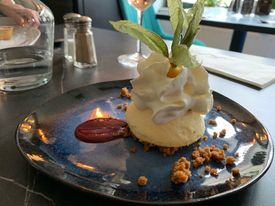
I’ve added a picture of the Sunday set menu, “Menu du Weekend.” You will notice the prices are higher, but the selections were a bit more decadent and the portions were bigger than one would receive on a weekday. If one wanted they could select, just one or two courses, but we went for all three! I selected the foie gras, the veau (veal), and the tartelette. Darrell ordered the tartare de saumon (yes, it’s raw), the veau, and the cheesecake served with coulis (which I learned just recently my mom also makes:)

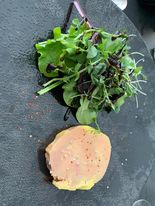
After we ordered our wine and menu items, they brought out the starter of risotto, then the entrée. I know some people have legitimate issues with the ethics of foie gras, to include King Charles not even allowing it to be served in the royal residences. If you don’t know what it is, feel free to look it up–I will say though that it was absolutely delicious and creamy at lunch that day; it is also a main product of SW France. Darrell’s salmon was lovely and cool and was topped with a citron and pepper sorbet. All of it perfectly seasoned.
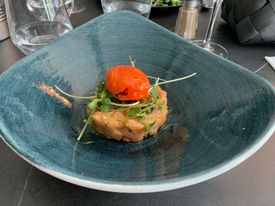
Then, we were served our Plats. Darrell would have gotten the fish option, which looked delicious at other tables, but he had started with salmon. Our veal was so tender you could cut with a butter knife–and the potatoes, well there are no words. Veal is another hotly debated selection, a matter of ethics for some, so I guess I was 0-2 in that area.
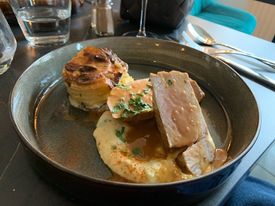
Finally, we were served our desserts. My tartelette was perfectly sweet and tart and Darrell’s cheesecake creamy and delicious. We’ve learned that French desserts are really not too sweet and are delicate to taste–they don’t overpower and are just the right size.

Finally, we finished with an espresso. Our entire lunch took about an hour and a half (and no, in true French fashion, we did not finish our bottle of wine–it just perfectly accompanied our food). At the end, we felt satisfied and not stuffed–even better we felt cared for. After each course, the chef came out (it is a small restaurant) and asked us what we thought–his smile wide each time we said, “tres, tres bien!” It was obvious he made it with amour and that he had paid close attention to how he was feeding us. Bon Appetit!


 A Cariad Life
Leave a reply to Lee Anne Barbara Cancel reply